01
World War II
The global war dominated the first half of the decade and reshaped borders, economies, societies and international power.
1940—1949 · WAR · HOME FRONT · POSTWAR WORLD
World war, mass mobilization, new technologies and a fragile peace transformed politics and everyday life, while bebop, film noir and postwar design pointed toward a very different future.
01 / Overview
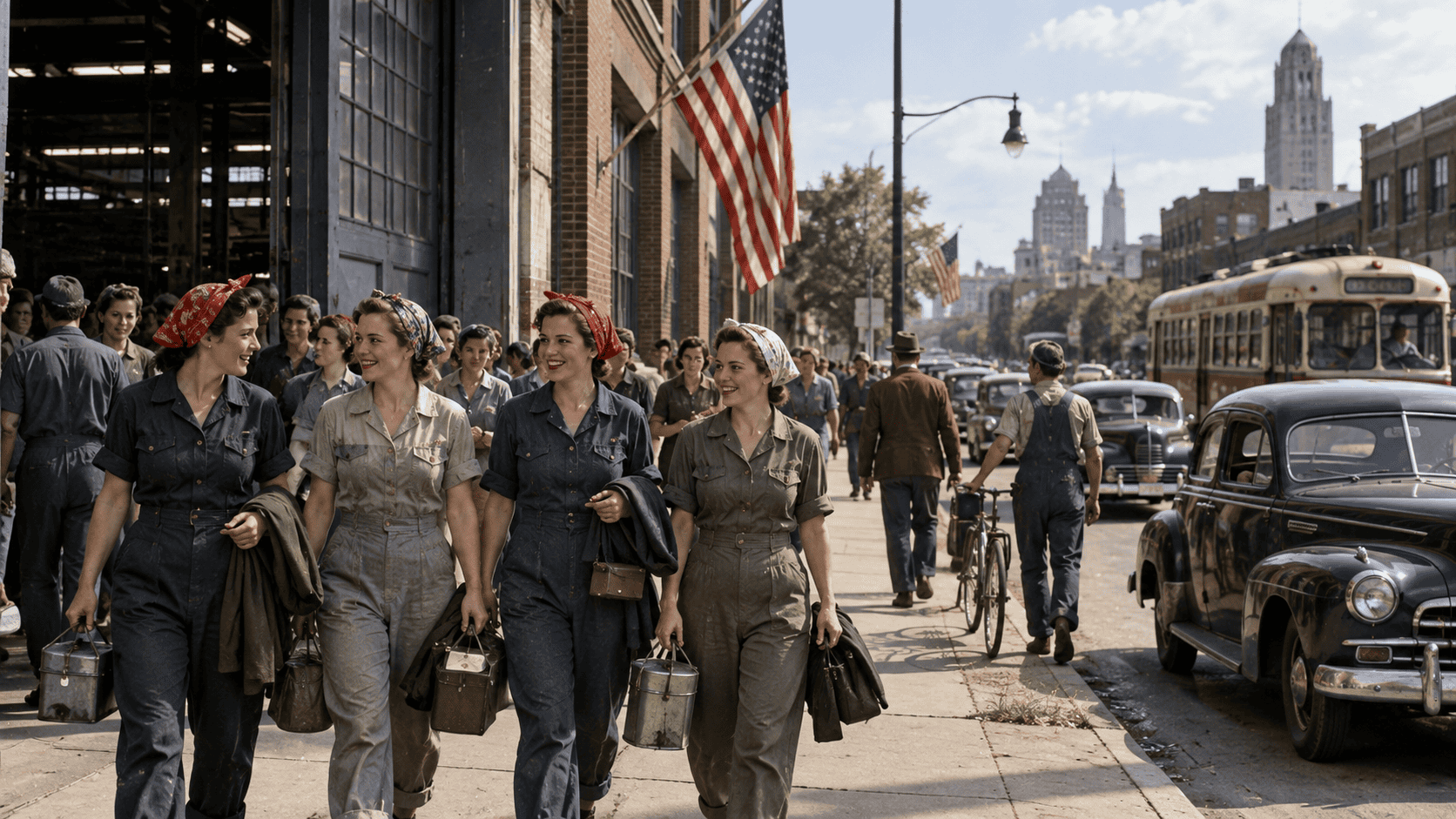
The 1940s opened with much of the world at war. World War II mobilized entire economies, moved millions of people, transformed industrial work and produced destruction on an almost unimaginable scale.
The United States entered the conflict after the Japanese attack on Pearl Harbor in December 1941, while civilians across the Allied and Axis worlds experienced rationing, displacement, bombing and mass mobilization.
The war ended in 1945 with the defeat of Nazi Germany and Imperial Japan, but peace immediately brought new tensions. The United Nations was founded, Europe began rebuilding and rivalry between the United States and Soviet Union hardened into the Cold War.
Decolonization accelerated as India and Pakistan became independent, while the establishment of Israel and the first Arab-Israeli war transformed politics in the Middle East.
Technology advanced rapidly under wartime pressure. Radar, jet aircraft, electronic computing, nuclear science, antibiotics and new communications systems all moved forward at extraordinary speed.
Culture reflected both anxiety and optimism. Film noir explored moral ambiguity, bebop reinvented jazz, radio remained powerful and Abstract Expressionism helped shift the center of the art world toward New York.
Fashion also moved between scarcity and abundance. Wartime utility clothing emphasized economy, while Christian Dior’s 1947 New Look returned volume and luxury to women’s dress.
02 / Events
The global war dominated the first half of the decade and reshaped borders, economies, societies and international power.
Nazi Germany and its collaborators murdered six million European Jews and millions of other victims in a campaign of persecution and genocide.
The United States used atomic bombs against the Japanese cities in August 1945, introducing nuclear weapons into warfare.
The United Nations officially came into existence in October 1945 after its Charter was signed and ratified.
Relations between the United States and Soviet Union deteriorated after World War II and hardened into a long geopolitical rivalry.
British rule ended in 1947 as India and Pakistan became independent amid mass migration and communal violence.
Israel declared independence in 1948, followed immediately by war with neighboring Arab states.
The Soviet blockade of land access to West Berlin in 1948–1949 led the Western Allies to supply the city by air.
Twelve countries signed the North Atlantic Treaty in Washington in April 1949.
Communist forces won the Chinese Civil War on the mainland and Mao Zedong proclaimed the People’s Republic in 1949.
International tribunals prosecuted leading Nazi officials and other defendants for war crimes and crimes against humanity.
Robinson joined the Brooklyn Dodgers in 1947 and broke Major League Baseball’s modern color barrier.
The Indian independence leader was killed in New Delhi in January 1948.
Polish resistance forces launched a major 1944 uprising against German occupation in Warsaw.
Allied forces landed in Normandy on June 6, 1944, opening a major Western Front against Nazi Germany.
The secret Allied research effort developed the first nuclear weapons during World War II.
Roosevelt, Churchill and Stalin met in February 1945 to discuss the final phase of the war and postwar Europe.
At the end of World War II, Soviet and American occupation zones divided the Korean Peninsula.
Winston Churchill’s 1946 speech described the growing political division of Europe.
The 1947 U.S. policy committed support to governments resisting communist pressure, beginning with aid to Greece and Turkey.
03 / Inventions
Military urgency and postwar research accelerated medicine, electronics, aviation, computing and consumer technology.
The compact four-wheel-drive military vehicle became one of the most recognizable machines of World War II.
Percy Spencer’s 1945 discovery that microwaves could heat food led toward the microwave oven.
Earl Tupper introduced lightweight airtight plastic food containers in the postwar years.
Bell Labs researchers demonstrated the first working transistor in 1947, transforming the future of electronics.
Edwin Land introduced the Polaroid Land Camera in 1948, allowing photographs to develop soon after exposure.
Portable pressurized spray systems were developed during the war to help soldiers control insects.
Bell System introduced commercial vehicle-based mobile telephone service in St. Louis in 1946.
Willem Kolff built a practical dialysis machine during the war, helping establish modern renal treatment.
Jacques Cousteau and Émile Gagnan developed an open-circuit scuba regulator system in 1943.
Richard James developed the famous walking spring toy during the decade.
Wartime shortages drove the United States to build a massive synthetic-rubber industry.
László Bíró’s modern ballpoint design entered commercial use during the 1940s.
Ralph Teetor developed an automatic speed-control system that would later reach passenger cars.
Glenn Seaborg and colleagues first produced and identified the new element during the early 1940s.
The large electronic computer was completed during the war and publicly unveiled in 1946.
Miniaturized radio technology allowed artillery shells to detonate automatically near a target.
Operational jet-powered aircraft demonstrated a new era of aviation during World War II.
Industrial methods made the antibiotic available on an unprecedented scale during the war.
The first controlled, self-sustaining nuclear chain reaction was achieved in 1942.
Wartime laboratories rapidly improved microwave radar for aircraft detection, navigation and fire control.
04 / Culture
The cultural landscape shifted from wartime morale and big-band entertainment toward more experimental music, darker cinema and new ideas about modern life.
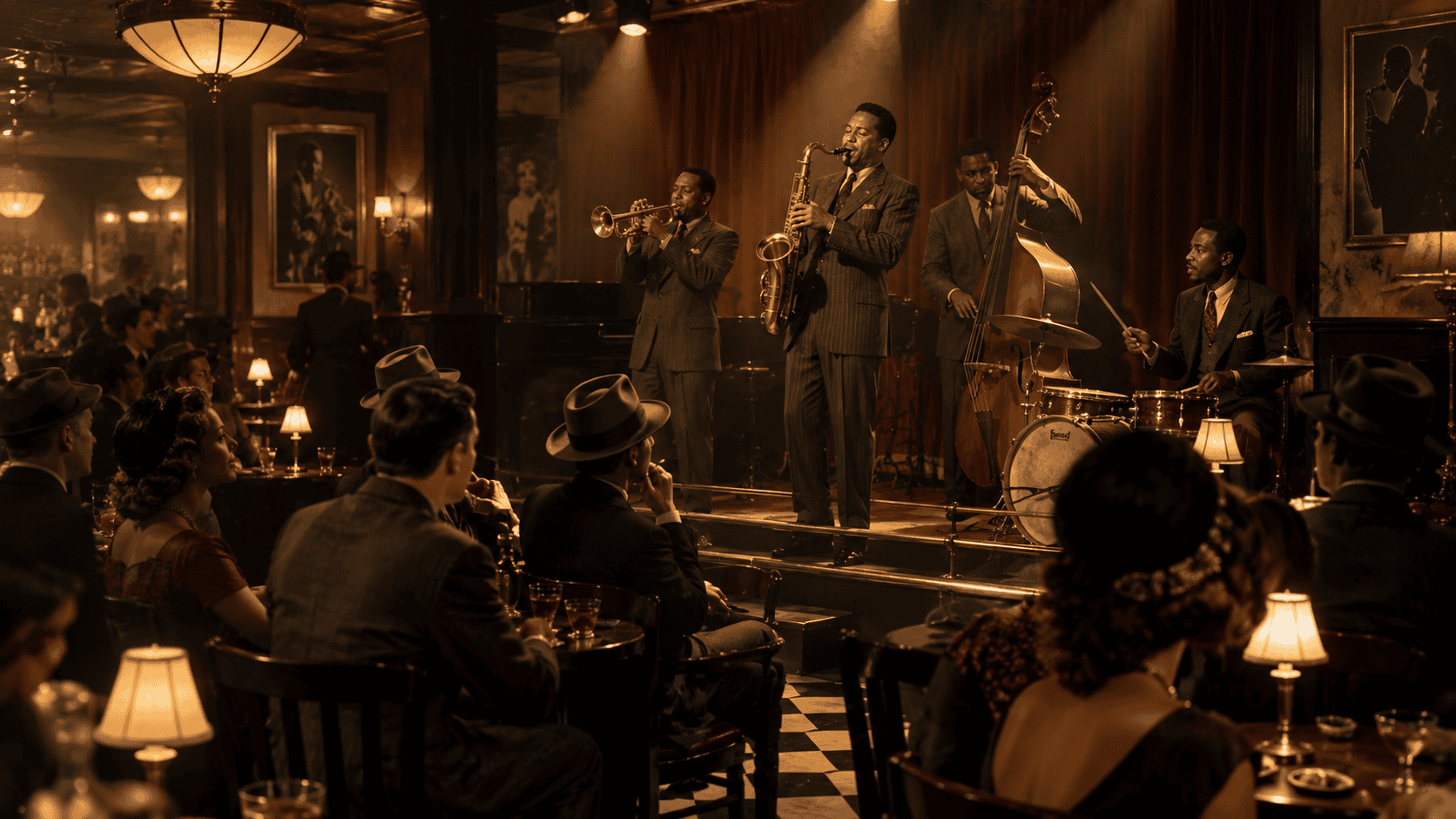
Fast tempos, complex harmony and improvisation transformed jazz through musicians such as Charlie Parker and Dizzy Gillespie.
Shadowy cinematography, morally ambiguous characters and crime stories gave Hollywood a darker postwar mood.
A new American art movement emerged around large canvases, gesture and abstraction.
Ideas about freedom, responsibility and individual existence gained broad cultural influence after the war.
Writers who would later define the Beat Generation began meeting and developing their ideas during the 1940s.
Illustrated and photographic pin-ups became especially visible in wartime popular culture.
Cheap paperbacks and sensational genre stories reached huge audiences.
Oversized suits became powerful symbols of style, youth identity and urban subculture.
Jitterbug and other swing dances remained hugely popular through much of the war era.
Radio remained a central source of news, comedy, drama, music and serialized entertainment.
Superheroes and adventure stories expanded their audience during wartime and after.
Casual restaurants and counters became familiar social spaces in American towns and cities.
Families grew vegetables at home to supplement food supplies and support wartime conservation.
Performers traveled to entertain service members at bases and overseas.
The wartime working woman became an enduring symbol of women’s industrial labor.
Nuclear science quickly entered newspapers, fiction, design and public imagination after 1945.
European émigré artists and established surrealists continued influencing American art.
Large orchestras remained central to popular music even as bebop challenged older jazz forms.
Coin-operated record players spread popular songs through diners, bars and social spaces.
Short cinema news films brought images of war, politics and public events to mass audiences.
05 / America
Publishing, finance, radio, jazz, art and returning servicemen kept New York at the center of American cultural life.
Hollywood expanded during and after the war while the metropolitan area experienced rapid population growth.
Heavy industry, rail transport, Black migration and a growing blues scene transformed the city.
Automobile factories converted to military manufacturing and helped earn the city the nickname Arsenal of Democracy.
The Pacific port played a major wartime role and hosted the 1945 conference that produced the United Nations Charter.
Federal wartime agencies, military planning and postwar diplomacy dramatically expanded the capital’s importance.
The secret Manhattan Project city became a major center of uranium enrichment.
Casinos, hotels and wartime migration accelerated the city’s emergence as an entertainment destination.
Tourism, military training and population growth reshaped South Florida during the decade.
Aircraft construction made Boeing and the Puget Sound region essential to wartime manufacturing.
Oil, shipbuilding and regional industry strengthened the city’s wartime and postwar economy.
Shipyards, factories and the University of Pennsylvania’s ENIAC project linked the city to war and computing history.
Transportation, military activity and postwar business growth strengthened Atlanta’s regional influence.
Universities, shipyards, electronics research and military work supported the region’s economy.
Its strategic port, jazz tradition and wartime shipbuilding kept the city connected to national change.
Steel mills operated at extraordinary scale to supply wartime and postwar industry.
Aircraft manufacturing and the launch of commercial mobile telephone service connected the city to wartime and communications history.
Shipbuilding, steel and port activity made Baltimore a key industrial center.
Naval bases and aircraft manufacturing drove enormous wartime expansion.
The attack on Pearl Harbor made Hawaii central to the Pacific War and transformed life across the islands.
06 / Fashion
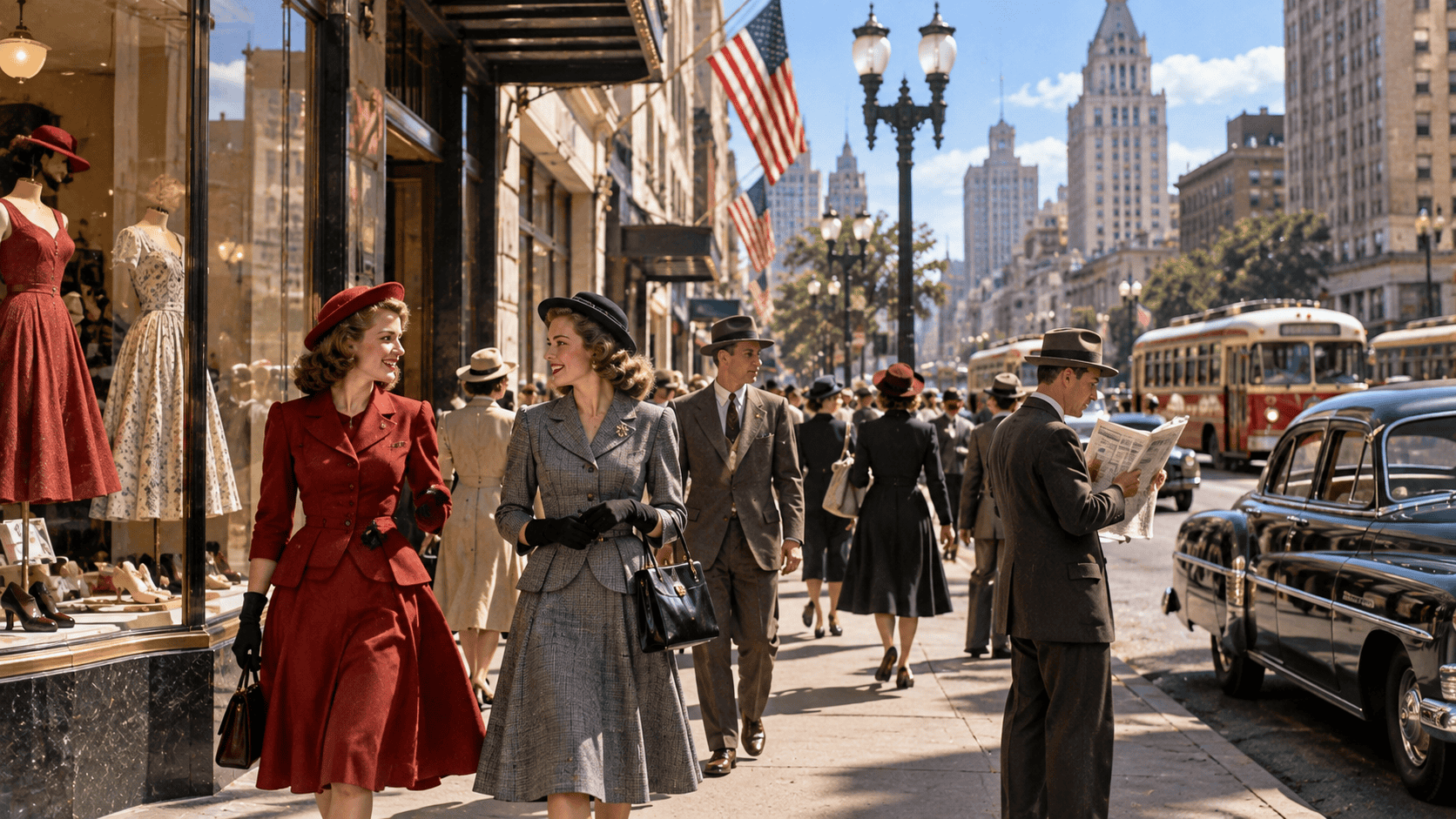
Wartime rules simplified clothing and conserved fabric, while the second half of the decade brought back volume, decorative detail and a stronger distinction between workwear and dress clothing.
Fabric rationing encouraged practical silhouettes, restrained decoration and economical cutting.
Structured shoulders gave women’s suits and dresses a strong wartime silhouette.
Men’s trousers sat at the natural waist and were often cut with pleats.
Men’s wartime suits used narrower cuts and less fabric.
When nylon stockings were scarce, some women drew dark lines down their legs to imitate seams.
Wrapped headwear was practical for factory work and became part of wartime fashion.
Thicker soles offered height while designers experimented with materials during wartime shortages.
Hair nets kept longer hairstyles controlled at work and became a recognizable accessory.
Short flared sections at the waist gave women’s tailoring a shaped silhouette.
Factory work made practical trousers increasingly visible in women’s everyday wardrobes.
Hawaiian and Pacific-inspired patterns became increasingly popular in casual clothing.
Folded ankle socks became a defining teenage style.
Soft felt hats remained essential to mainstream men’s dress.
Shorter evening dresses offered a less formal alternative to full-length gowns.
Two-tone lace-up shoes were especially popular with young people.
Matching cardigans and pullovers became polished staples of women’s casual dress.
Long coats and extremely full trousers created a deliberately exaggerated urban silhouette.
Loose embroidered tops drew on folk and regional clothing traditions.
The 1947 silhouette emphasized a narrow waist, rounded shoulders and dramatically full skirts.
The modern two-piece swimsuit debuted in Paris in 1946 and challenged contemporary expectations of beachwear.
07 / Movies
Hollywood moved between wartime drama, romance, noir, animation and postwar disillusionment, while Italian neorealism changed international cinema.
Orson Welles used deep focus, unusual structure and bold visual storytelling in his portrait of a newspaper tycoon.
The wartime romance combined politics, sacrifice and memorable performances in occupied North Africa.
John Huston’s detective film helped define the emerging style of film noir.
Frank Capra’s drama examined community, family and personal worth in small-town America.
Billy Wilder’s crime drama became a defining example of film noir.
The film portrayed veterans struggling to rebuild civilian lives after World War II.
A tense postwar thriller used Vienna’s ruins as a setting for moral ambiguity and intrigue.
Humphrey Bogart and Lauren Bacall starred in a famously complex noir mystery.
David Lean’s restrained romance followed two married strangers who fall in love.
Italian neorealism found extraordinary emotional power in an ordinary family’s economic struggle.
Powell and Pressburger combined dance, color and psychological drama in a celebrated ballet film.
Alfred Hitchcock mixed romance, espionage and suspense in a postwar thriller.
John Huston explored greed and paranoia through a gold-prospecting story.
The wartime adventure became famous for the chemistry between Humphrey Bogart and Lauren Bacall.
Katharine Hepburn, Cary Grant and James Stewart led a sharp romantic comedy.
Disney combined classical music with ambitious experimental animation.
John Ford adapted John Steinbeck’s Depression-era novel into a major social drama.
The New York holiday film mixed sentiment, skepticism and department-store spectacle.
Charlie Chaplin satirized fascism and dictatorship while the war in Europe was underway.
James Cagney’s volatile gangster performance pushed crime cinema toward a harsher postwar style.
08 / Music
Popular music stretched from swing and crooners to electric blues, country, gospel, rhythm and blues and the increasingly adventurous language of modern jazz.
Charlie Parker and Dizzy Gillespie helped create a fast, harmonically complex new language of jazz.
Driving blues piano rhythms crossed into swing bands and popular entertainment.
The folk songwriter chronicled workers, migration and American life in direct, memorable songs.
Her phrasing and emotional intensity made her one of the decade’s most distinctive jazz singers.
The young crooner became a mass-audience phenomenon through radio, records and live appearances.
Close vocal harmony and upbeat wartime songs made the trio enormously popular.
The pianist and singer moved from sophisticated jazz trio performances toward mainstream vocal success.
The French singer’s intense performances brought chanson to an international audience.
His move to Chicago helped shape the amplified urban blues sound that would influence rock and roll.
His songwriting and vocal style became foundational to modern country and honky-tonk.
The term came into use late in the decade for music rooted in Black blues, jazz and dance-band traditions.
Her restrained, intimate vocal style distinguished her in swing and popular music.
The guitarist experimented with electric-guitar design and pioneering multitrack recording techniques.
Big-band singing and film appearances helped launch her into major postwar stardom.
The singing cowboy linked western music, radio and Hollywood.
Her powerful gospel singing and electric guitar influenced rhythm and blues and early rock musicians.
The baritone vocalist and bandleader became known for romantic popular songs.
The vocal group remained famous for close harmonies and instrumental imitation.
Mambo and Afro-Cuban rhythms gained growing attention in American clubs toward the end of the decade.
The country singer reached audiences through records, radio and crossover hits.
09 / Cars
Wartime restrictions halted much civilian car development, but after 1945 manufacturers raced to satisfy years of pent-up demand with new models and new styling.
The rugged four-wheel-drive military vehicle became one of the decade’s most recognizable machines.
The prewar and early postwar Ford combined familiar V8 power with streamlined bodywork.
Wood body trim gave the luxury model an unmistakable appearance.
Postwar styling, powerful V8 engines and rich interiors established a new American luxury image.
Its sweeping fastback roofline made the car a familiar sight in the mid-1940s.
Streamlined proportions bridged prewar design and postwar luxury.
The economical car became known for distinctive postwar styling.
Late-decade step-down construction lowered the passenger compartment and center of gravity.
Large dimensions, straight-eight power and comfort made it a premium American touring car.
Conservative styling and practical engineering appealed to mainstream families.
Its long hood, low roof and continental spare influenced luxury-car design.
The upscale Oldsmobile combined large-car comfort with Hydra-Matic automatic transmission.
Silver Streak trim and smooth bodywork gave the model a strong visual identity.
Postwar Mercury styling became especially influential in later custom-car culture.
Rounded fenders and practical construction made it a familiar family car.
Unit-body construction and fuel economy distinguished the innovative sedan.
The mid-priced Chrysler division offered spacious cars with flowing late-1940s styling.
Tiny economical cars offered an unusual alternative to mainstream American automobiles.
Advanced ideas and dramatic styling made Preston Tucker’s short-lived sedan a legend.
One of the new postwar independent cars, the Kaiser offered fresh styling to buyers hungry for new automobiles.
Legacy
The 1940s redrew the political map, created the United Nations, launched the nuclear age and laid many of the institutional foundations of the Cold War.
It also accelerated technologies that would define later decades, from electronic computing and transistors to antibiotics, radar and jet aviation.
Culturally, the decade bridged the mass entertainment of the big-band era and a more complicated postwar world of bebop, film noir, modern art and changing consumer expectations.
11 / FAQ
The decade is remembered for World War II, the Holocaust, the atomic age, the founding of the United Nations, the early Cold War, postwar reconstruction, bebop, film noir and dramatic changes in technology and fashion.
Rationing, military service, factory work, migration, propaganda and shortages reshaped work, family life, transportation, clothing and consumer habits.
Radar, jet aviation, electronic computing, nuclear science, mass penicillin manufacture and the transistor all marked major technological shifts.
Swing remained enormously popular while bebop, rhythm and blues, country, gospel and electric blues pointed toward postwar music.
Wartime fabric-saving silhouettes gave way after 1947 to fuller skirts, narrower waists and more luxurious materials associated with Dior’s New Look.
The decade created institutions, technologies, alliances, cultural forms and geopolitical tensions that shaped much of the second half of the twentieth century.